


TL;DR:
- Precision in defense manufacturing involves strict, measurable tolerances critical for system reliability.
- Manufacturing errors at any supply chain stage can cause significant mission failures and safety risks.
- A culture of cross-functional organizational discipline is essential for consistent high-precision defense production.
When a weapons system fails in the field, the cause rarely traces back to a bold design flaw. It traces back to a tolerance that slipped, a surface finish that deviated, or a supplier that cut corners on inspection. 20-60% failure rates documented in advanced Russian cruise missiles aren’t an anomaly. They’re a warning. This guide covers what precision actually means in defense manufacturing, how it directly drives mission reliability, which technologies deliver it consistently, and what procurement leaders must demand from their supply chains to avoid becoming a cautionary example.
Table of Contents
- What precision means in the defense sector
- How precision impacts reliability and mission success
- Key technologies and methods for achieving extreme precision
- Procurement and quality control: Ensuring precision end-to-end
- The uncomfortable truth about precision no one tells you
- Explore precision machining solutions for your defense needs
- Frequently asked questions
Key Takeaways
| Point | Details |
|---|---|
| Precision prevents failures | Minor machining errors can cause major defense system malfunctions or mission failure. |
| Exact standards matter | Strict tolerances and compliance with industry standards are non-negotiable for operational safety. |
| Technology enables accuracy | Investing in advanced machining and measurement technologies consistently delivers higher reliability. |
| Quality starts with procurement | Selecting capable suppliers and maintaining rigorous quality control safeguards precision throughout production. |
What precision means in the defense sector
Precision in defense manufacturing isn’t a marketing term. It’s a measurable, enforceable standard that separates functional systems from catastrophic failures. At its core, precision refers to the ability to produce a component within a specified dimensional tolerance, repeatedly, across every unit in a production run.
For defense applications, tolerances are tighter than virtually any other industry. A commercial automotive part might be acceptable within ±0.010 inches. A firearm barrel or missile guidance ring may require ±0.001″ machining tolerances or tighter. That’s a tenfold difference, and every decimal point matters when a component must function reliably under extreme temperature, pressure, and mechanical stress.
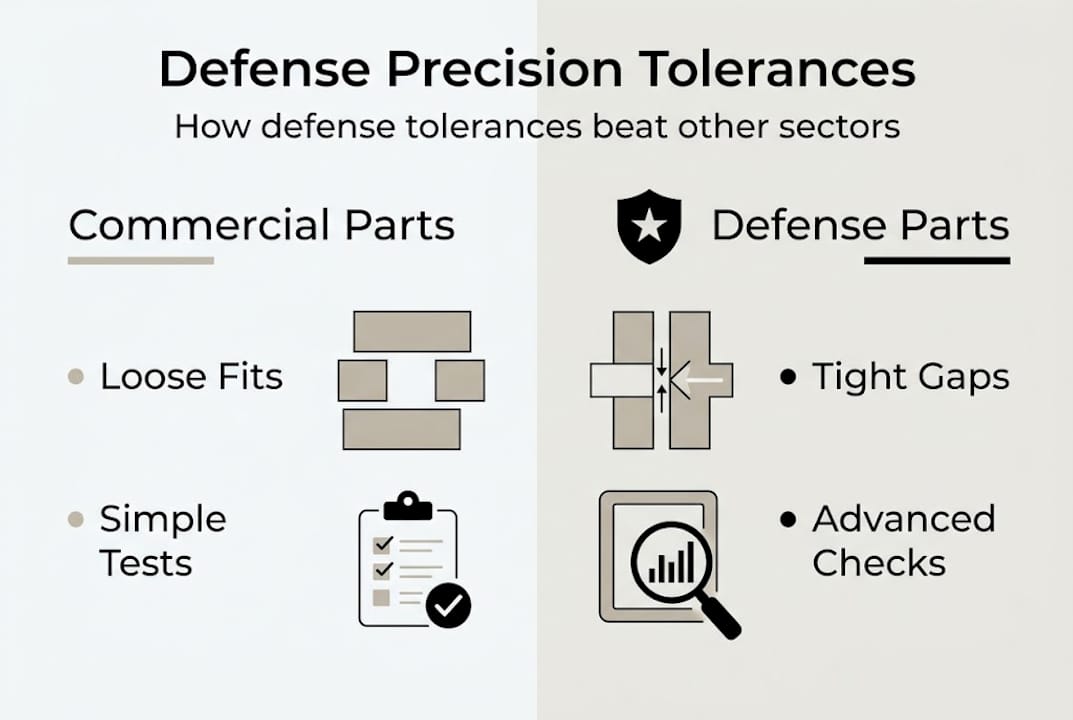
The standards that govern this level of work are specific and demanding. MIL-STD specifications define dimensional, material, and performance requirements for military components. AS9100 certification governs quality management systems in aerospace and defense supply chains. These aren’t optional frameworks. They’re the baseline for any supplier serious about defense work.
Tolerance comparison for common defense components:
| Component | Acceptable tolerance | Standard applied |
|---|---|---|
| Firearm barrel bore | ±0.0005″ | MIL-SPEC |
| Missile guidance ring | ±0.001″ | AS9100 / MIL-STD |
| Structural airframe element | ±0.005″ | AS9100 |
| Electronic housing | ±0.003″ | MIL-STD |
| Hydraulic actuator bore | ±0.0008″ | MIL-SPEC |
The side effects of imprecision go beyond a rejected part. A single out-of-tolerance component can trigger assembly failures, delay deployment timelines, and create safety risks that compound across an entire platform. Manufacturing defects have been directly linked to significant failure rates in advanced military weaponry, confirming that precision is not a quality-of-life issue. It’s a mission-critical requirement.
The operational impacts of imprecision include:
- Increased maintenance cycles that pull assets out of service
- Mission abort rates tied to component unreliability
- Cost overruns from rework, replacement, and root cause investigations
- Safety incidents caused by mechanical failure under load
Pro Tip: When evaluating a new supplier, ask specifically for their Cpk (process capability index) data. A Cpk above 1.67 indicates a process capable of producing within tight defense tolerances consistently. Anything below 1.33 is a red flag for high-stakes applications.
True precision in defense is about precision and innovation in defense working together as a system, not as separate checkboxes on a contract.
How precision impacts reliability and mission success
With precision defined, the consequences of not achieving it become starkly clear. Reliability in defense systems is not an abstract concept. It’s the probability that a weapon, vehicle, or platform performs its intended function when called upon. Precision manufacturing is the single largest controllable variable in that equation.
“A system is only as reliable as its least precise component. In defense, that statement isn’t a management principle. It’s an engineering reality.”
The Russian Kh-101 cruise missile program offers one of the most documented modern examples. 20-60% of advanced Russian missiles fail due to manufacturing imprecision, according to field assessments. For a program representing billions in development investment, that failure rate is operationally catastrophic and financially devastating.
Precision failures don’t happen randomly. They occur at predictable points in the supply chain:
- Raw material sourcing where inconsistent alloy composition introduces variability before machining begins
- Initial machining operations where worn tooling or inadequate fixturing introduces dimensional drift
- Secondary operations such as heat treatment or surface finishing that alter dimensions if not properly sequenced
- Sub-assembly integration where tolerance stack-up across multiple parts creates interference or misalignment
- Final inspection where inadequate measurement capability fails to catch marginal parts
- Field deployment where environmental stress exposes latent defects that passed inspection
Each of these stages represents a decision point where discipline either holds or breaks. The financial impact of failures at later stages multiplies rapidly. A defect caught at raw material sourcing costs cents to address. The same defect discovered during final system integration can cost thousands. Discovered in the field, it costs missions and lives.
Reliability in defense projects is typically measured through Mean Time Between Failures (MTBF) and mission reliability rates. Programs with rigorous precision manufacturing controls consistently outperform those that treat tolerance compliance as a secondary concern. Engineering firearms for accuracy follows the same discipline: every process step is controlled, documented, and verified before the next begins.

Understanding the firearms machining workflow illustrates how this sequential discipline applies across defense component categories, not just small arms.
Key technologies and methods for achieving extreme precision
Given the challenges that precision failures create, top-tier defense manufacturers eliminate risk through technology selection, process control, and continuous verification. The machines matter. But the systems surrounding them matter just as much.
Advanced manufacturing technologies play a critical role in achieving the tight tolerances required for defense reliability. Here’s how leading technologies map to specific defense applications:
Technology-to-application mapping:
| Technology | Defense application | Precision capability |
|---|---|---|
| CNC milling | Airframe structures, housings | ±0.001″ |
| CNC turning | Shafts, barrels, actuator rods | ±0.0005″ |
| Wire EDM | Guidance components, complex profiles | ±0.0002″ |
| CMM inspection | Final dimensional verification | ±0.00005″ |
| In-line metrology | Real-time process correction | Continuous |
| Hydromat systems | High-volume rotary transfer parts | ±0.001″ |
Automation plays a growing role in defect prevention. When a CNC machine is paired with in-process gauging, it can detect dimensional drift and self-correct before producing an out-of-tolerance part. This closed-loop approach removes human variability from the most critical process steps. It’s why CNC automation in aerospace has become the standard for programs where failure is not an option.
Digital workflows add another layer of control. When process parameters, inspection data, and material certifications are captured and linked to individual part serial numbers, traceability becomes complete. Any future failure can be traced back to the exact machine, operator, tool, and material lot. That level of accountability changes how suppliers approach every production run.
Pro Tip: When specifying process controls for a new defense contract, require Statistical Process Control (SPC) charting on all critical dimensions. SPC data reveals trends before they become defects, giving you the ability to intervene proactively rather than react to failures.
Optimizing industrial measurement processes is increasingly recognized as a competitive differentiator, not just a compliance requirement. Suppliers who invest in measurement infrastructure produce better parts and catch problems earlier.
The combination of capable machines, automated inspection, and digital traceability is what separates a supplier capable of meeting defense tolerances from one who merely claims to. Reviewing precision parts manufacturing quality standards gives procurement teams a concrete benchmark for evaluating supplier readiness.
Procurement and quality control: Ensuring precision end-to-end
Precision isn’t just about machines. It’s a discipline that touches every step of procurement and quality assurance. The most advanced machining center in the world produces scrap if the incoming material is inconsistent or the inspection protocol is inadequate.
Defense component failures can originate from any breakdown in procurement or manufacturing discipline, which is why end-to-end quality ownership is non-negotiable for serious defense programs.
Supplier vetting must go beyond reviewing a certificate of compliance. Effective vetting examines process capability data, quality management system maturity, and the supplier’s track record on comparable programs. Certifications like AS9100 and ITAR registration are entry-level requirements, not differentiators.
Key questions every procurement leader should ask a precision supplier:
- What is your documented Cpk for the critical dimensions on this part family?
- How do you handle material traceability from incoming inspection through final shipment?
- What is your first-article inspection process, and how is it documented?
- Can you provide SPC data from recent production runs on similar tolerances?
- What is your non-conformance rate, and how are corrective actions tracked?
- How do you manage tooling wear and its impact on dimensional consistency?
In-process inspection is where most quality failures are caught or missed. A supplier relying solely on final inspection is accepting risk that should have been eliminated upstream. The most effective quality systems use inspection gates at each major operation, not just at the end of the line.
Common procurement pitfalls include accepting supplier self-certification without audit, failing to define inspection frequency in the purchase order, and neglecting to require first-article inspection on new part numbers. Each of these gaps has produced real defense program failures.
Using a structured sourcing guide for aerospace defense helps procurement teams build the right evaluation framework before a contract is awarded, not after a problem surfaces. Integrating production metrology for quality requirements into supplier contracts ensures measurement capability is specified, not assumed.
The uncomfortable truth about precision no one tells you
After decades of working with defense and aerospace programs, the pattern is consistent: most precision failures don’t start on the machine floor. They start in a conference room.
Precision is not a technology. It’s an organizational mindset. A facility can own every advanced machine on the market and still produce out-of-tolerance parts if leadership doesn’t treat precision as a cultural value. When schedule pressure overrides process discipline, when cost reduction targets compromise inspection frequency, or when supplier audits are treated as administrative formalities, the machine floor inherits decisions it cannot fix.
The programs that achieve the highest reliability rates share one characteristic: cross-functional alignment. Engineering, procurement, quality, and production all operate from the same precision standard. There’s no gap between what the drawing specifies and what procurement demands from suppliers.
For defense executives, the lesson from studying custom machining lessons in high-stakes programs is this: your precision posture is only as strong as your weakest organizational decision. Invest in the culture before you invest in the equipment.
Explore precision machining solutions for your defense needs
If this guide has clarified the stakes around precision in defense manufacturing, the next step is connecting that understanding to a supplier capable of delivering it consistently. At Machining Technologies LLC, we’ve been producing high-precision defense and aerospace components since 1985, with over 20 million parts manufactured annually across a 70,000 square foot facility equipped with Hydromat systems, CNC milling, turning, and wire EDM.
Whether you’re evaluating suppliers for a new program, conducting an audit readiness review, or scaling from prototype to full production, we provide the process controls, certifications, and traceability that defense procurement demands. Explore our firearms precision machining capabilities, review our parts manufacturing quality standards, or learn how we optimize the aerospace machining workflow for high-volume defense contracts.
Frequently asked questions
What are common failure rates when precision is lacking in defense manufacturing?
Failure rates can reach 20-60% in advanced systems when manufacturing precision is not maintained across the supply chain. Even marginal tolerance deviations compound across integrated systems.
How is precision measured in defense machining?
Precision is measured through dimensional tolerances, process capability indices like Cpk, and compliance with standards such as MIL-STD and AS9100. Coordinate Measuring Machines (CMMs) provide the highest-accuracy verification.
What technologies improve machining accuracy for defense products?
CNC milling, turning, wire EDM, and in-line metrology systems are the leading technologies for achieving and verifying tight tolerances in defense component production. Closed-loop automation further reduces dimensional drift.
What role does procurement play in achieving defense precision?
Procurement sets the standard by defining supplier qualification requirements, specifying inspection protocols in contracts, and enforcing traceability from raw material through final delivery. Weak procurement discipline is a direct path to field failures.
Recommended
- Precision machining: engineering firearms for accuracy & compliance | Machining Technologies
- Machining in defense industry: precision and innovation | Machining Technologies
- Precision Parts Manufacturing: Maximizing Quality and Throughput | Machining Technologies
- 7 Key Benefits of Precision Machining for Manufacturers | Machining Technologies