

TL;DR:
- Selecting a reliable machining partner requires clear specifications, technical evaluation, and quality assurance.
- Specialized shops with proven certifications and strong process controls significantly reduce defects and delays.
- Focusing on total cost of ownership and supplier behavior ensures long-term OEM success over initial pricing.
Choosing the wrong contract machining partner is not a minor inconvenience. A single batch of out-of-tolerance parts or a missed delivery window can halt your production line, trigger penalty clauses, and damage customer relationships that took years to build. For procurement managers and engineers at OEMs, the selection process deserves the same rigor you apply to your own manufacturing floor. This guide walks you through a proven, step-by-step process for evaluating and selecting a contract machining partner who can handle high-volume, precision work without compromising your schedule or quality standards.
Table of Contents
- Define your requirements and build your shortlist
- Evaluate technical capabilities and specialization
- Assess quality systems, certifications, and traceability
- Analyze pricing, lead times, and support structure
- Expert perspective: Beyond checklists to true partnerships
- Partner with machining experts for OEM results
- Frequently asked questions
Key Takeaways
| Point | Details |
|---|---|
| Clarify requirements | Detailed technical and quality needs let you accurately screen machining partners. |
| Prioritize specialization | A partner’s experience with your parts and industry often predicts reliability and fewer defects. |
| Demand quality proof | Only consider vendors who provide up-to-date certifications and sample inspection reports. |
| Go beyond price | Look at lead time, flexibility, and communication in addition to cost when selecting a partner. |
Define your requirements and build your shortlist
Before you send a single RFQ (Request for Quote), you need a clear picture of exactly what you need. Vague specifications invite vague answers, and vague answers lead to surprises on the shop floor. Start by documenting every critical requirement: part tolerances, acceptable materials, surface finish specifications, annual volume, and any industry certifications the supplier must hold.
This upfront investment pays off fast. OEMs that clearly communicate critical tolerances and volumes are 30% more likely to avoid production delays. That single statistic should motivate you to get your technical package right before reaching out to anyone.
When building your shortlist, use a structured screening checklist to filter candidates quickly:
- Part complexity: Can they machine the geometry your design requires?
- Material experience: Do they regularly work with your specified alloys or engineered plastics?
- Volume capacity: Can they sustain your annual run rate without bottlenecks?
- Quality certifications: Do they hold ISO 9001, AS9100, or ITAR registration if your application demands it?
- Lead time history: What is their documented on-time delivery rate?
- Geographic proximity: Does location affect logistics, tooling visits, or emergency response?
Aim to narrow your initial pool to three to five candidates. More than that and the evaluation process becomes unwieldy. Fewer than three and you lose competitive leverage.
Understanding whether you need custom vs standard machining also shapes your shortlist. Custom work demands a partner with engineering depth. Standard catalog-style parts allow for a broader candidate field.
| Requirement category | What to document |
|---|---|
| Dimensional tolerances | ±0.001″ or tighter, per feature |
| Surface finish | Ra value in microinches or micrometers |
| Material | Alloy grade, heat treat condition |
| Annual volume | Units per year, batch size |
| Certifications required | ISO 9001, AS9100, ITAR |
| Delivery expectation | Lead time in weeks, buffer stock needs |
Pro Tip: Never assume a shop can handle your part because they list the right equipment. Ask for documented examples of similar parts they have produced, including inspection results.
Evaluate technical capabilities and specialization
Once you have your shortlist, the real evaluation begins. A machine list on a website tells you what equipment a shop owns. It does not tell you whether their team can consistently hold your tolerances on your material at your volume. You need to dig deeper.
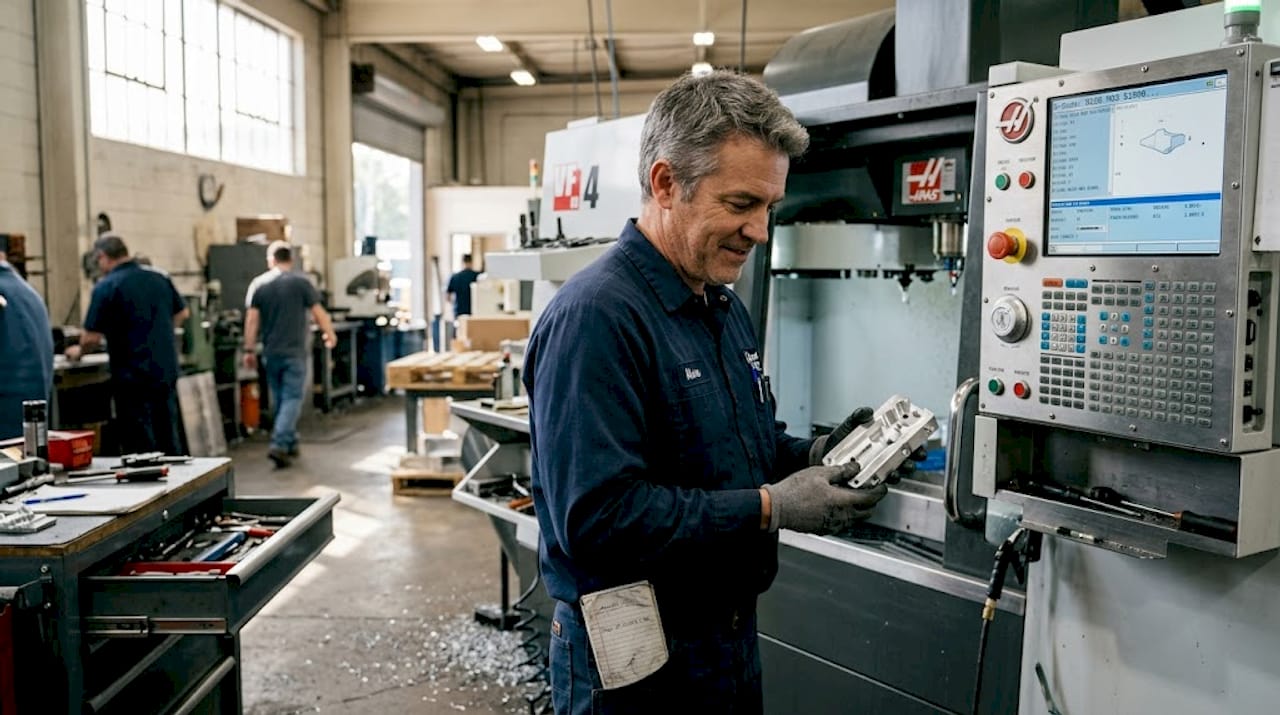
Start by reviewing their portfolio with a critical eye. Look for parts that share geometric complexity, material type, or tolerance requirements with your own. A shop that specializes in aerospace machining best practices will approach a titanium bracket very differently from a general job shop that occasionally runs titanium.
Specialization matters more than most procurement teams realize. Selecting a partner with specialized process expertise can reduce defect rates by up to 40%. That is not a marginal improvement. At high volumes, a 40% reduction in defects translates directly to fewer line stoppages, less rework, and stronger margins.
Here is a structured approach to verifying technical fit:
- Request a machine list with age and condition data. Older equipment is not automatically disqualifying, but it signals where their investment priorities lie.
- Ask about multi-axis CNC capability. Five-axis machining enables complex geometries in fewer setups, reducing error accumulation.
- Confirm EDM and turning capacity. Wire EDM and CNC turning are often critical for tight-tolerance features that milling alone cannot achieve.
- Review their fixturing and tooling philosophy. Custom fixturing for your part shows commitment and reduces cycle time variation.
- Ask about their process for high-volume workflow optimization. Shops with documented workflow systems handle volume spikes more predictably.
Use a comparison table to score each candidate against your specific technical requirements. Assign weights to the criteria that matter most for your application.
| Capability | Candidate A | Candidate B | Candidate C |
|---|---|---|---|
| 5-axis CNC | Yes | Yes | No |
| Wire EDM | Yes | No | Yes |
| Hydromat / rotary transfer | Yes | No | No |
| Aerospace portfolio examples | Strong | Moderate | Weak |
| Tolerance capability (±0.001″) | Confirmed | Unverified | Confirmed |
Pro Tip: Ask each candidate to describe how they would approach your specific part. The quality of that answer reveals far more about their engineering depth than any brochure.
Assess quality systems, certifications, and traceability
Technical capabilities mean little without proven quality and compliance systems backing them up. This is the stage where many procurement teams make a costly mistake: they accept a supplier’s word on quality rather than demanding documented evidence.
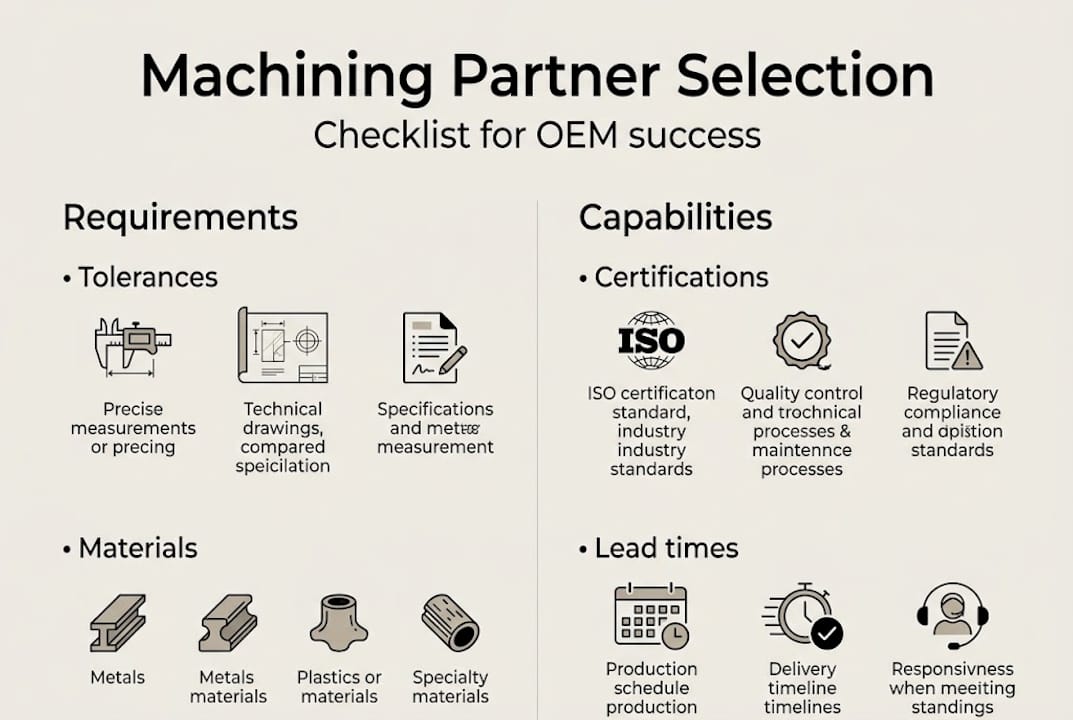
Certifications are your first filter. ISO 9001 and AS9100 certifications are standard for aerospace suppliers, and shops holding both consistently score 95% or higher in OEM audits. If your application touches defense programs, ITAR (International Traffic in Arms Regulations) registration is non-negotiable.
Beyond certifications, ask for specifics:
- Inspection routines: What percentage of parts are inspected? At what stages in the process?
- CMM (Coordinate Measuring Machine) capability: Do they have in-house CMM equipment, or do they outsource dimensional inspection?
- First Article Inspection (FAI) process: Can they provide a sample FAI report for a comparable part?
- Lot traceability: Can they trace a specific part back to its raw material heat number, machine, operator, and inspection record?
- Corrective action process: How do they document and resolve non-conformances?
Traceability is especially critical for regulated industries. If a field failure occurs, you need to isolate the affected lot within hours, not days. A partner without robust lot tracking puts your entire supply chain at risk.
“After switching to a certified partner with full CMM traceability, one aerospace OEM reduced their incoming inspection rejection rate from 4.2% to under 0.5% within two production cycles. The certification was not just a badge. It reflected a fundamentally different approach to process control.”
For more detail on what to look for during supplier audits, reviewing guidance on verifying machined part quality can sharpen your checklist. If you are also weighing whether to subcontract machining versus keeping work in-house, quality system maturity is a key factor in that decision.
Pro Tip: Request a sample FAI or CMM report before awarding any business. A supplier who hesitates to share this documentation is telling you something important.
Analyze pricing, lead times, and support structure
After vetting quality and capabilities, quotes and support can tip the scales. But comparing quotes on unit price alone is one of the most common and expensive mistakes OEMs make. The right framework is total cost of ownership (TCO), which accounts for far more than what appears on the invoice.
Here is how to structure a TCO comparison:
- Unit price: The starting point, not the finish line.
- Tooling and setup costs: Are these amortized over the run, or billed separately?
- Scrap and rework rates: A lower unit price from a high-scrap supplier costs more in the end.
- Freight and logistics: Distance and packaging requirements affect landed cost.
- Penalty clause exposure: What happens if they miss a delivery? Who absorbs the cost?
Lead time reliability deserves its own weight in your evaluation. OEMs report 40% faster average lead times from partners with advanced scheduling systems. In competitive markets, that speed advantage directly accelerates your time-to-market.
| Quote element | Supplier A | Supplier B | Supplier C |
|---|---|---|---|
| Unit price (1,000 pcs) | $4.20 | $3.85 | $4.50 |
| Setup / tooling cost | $800 | $2,200 | $600 |
| Quoted lead time | 3 weeks | 5 weeks | 3 weeks |
| On-time delivery rate | 98% | 87% | 95% |
| Engineering support included | Yes | No | Yes |
Also evaluate the support structure beyond production. Can they respond quickly to engineering change orders? Do they offer dedicated account management? Will they flag potential design-for-manufacturability issues before cutting metal? These capabilities have real dollar value when your design evolves mid-production.
The contract machining benefits that matter most to OEMs go well beyond price. Responsiveness, flexibility, and shared accountability are what separate a vendor from a true production partner.
Expert perspective: Beyond checklists to true partnerships
Every step in this guide matters. But here is something most selection frameworks do not say plainly: the data you collect during evaluation only tells you what a supplier has done. It does not guarantee what they will do when your volume doubles, your design changes, or a critical delivery falls on a holiday week.
The best indicator of long-term reliability is how a supplier behaves when things get hard. Place a test order before committing to a full production contract. Watch how they communicate during that run. Do they proactively flag issues, or do you find out at receiving inspection? That behavior pattern is far more predictive than any audit score.
Experienced OEMs also avoid the trap of optimizing purely on price. A supplier who wins on price alone has no margin to invest in your relationship. The shops worth keeping are the ones who push back on your design when they see a manufacturability risk, and who treat your delivery schedule like their own.
Look for evidence of a continuous improvement culture. Do they track and publish their own defect rates? Have they invested in new equipment recently? Are their operators cross-trained? These signals indicate a partner who is building capability, not just filling capacity. When evaluating choosing the right machining fit, that culture of improvement often matters more than any single machine on their floor.
Partner with machining experts for OEM results
When you are ready to move from evaluation to execution, the partner you choose will shape every production outcome that follows.
At Machining Technologies LLC, we have supported OEMs across aerospace, defense, firearms, and industrial manufacturing since 1985, producing over 20 million parts annually from our 70,000 square foot facility in Webster, Massachusetts. Our team is ready to review your requirements, provide detailed quotes, and demonstrate our quality systems firsthand. Whether you need support for complex part manufacturing, high-volume runs, or regulated-industry compliance, we bring the capacity and expertise to deliver. Explore the full range of contract machining benefits we offer, or learn more about our OEM precision machining capabilities and request a quote today.
Frequently asked questions
What certifications should my machining partner have?
ISO 9001 and AS9100 certifications are essential for aerospace suppliers, while ITAR registration is required for any defense-related parts. Always verify that certifications are current and scope-matched to your specific application.
How can I verify a machining partner’s precision and quality?
Request documented inspection reports such as CMM data or First Article Inspection results, and review their quality audit history. Sample FAI reports give you direct evidence of a supplier’s capability before you commit to production volume.
Is it better to work with a specialized or general machining shop?
Specialized partners consistently outperform general shops on critical parts. Selecting process specialists can reduce defect rates by 40%, making specialization a clear advantage when tolerances and reliability are non-negotiable.
What’s a common pitfall when choosing a machining partner?
Prioritizing low unit price over total value is the most costly mistake OEMs make. Lead time reliability impacts true project ROI far more than the quoted price, especially when production delays trigger downstream penalties.
Recommended
- OEM contract machining: Streamline precision for high-volume production | Machining Technologies
- Custom vs standard machining: choosing the right fit | Machining Technologies
- Subcontract Machining: Boost OEM Precision & Efficiency | Machining Technologies
- Why Automate Machining Processes: Boosting OEM Efficiency | Machining Technologies