

TL;DR:
- Most machining operations operate at high utilization but still struggle with delays, WIP buildup, and rework due to the misconception that utilization equals efficiency. Lean machining applies principles like value stream mapping, 5S, and SMED to eliminate waste, improve flow, and shorten lead times, especially in high-precision environments like aerospace. Success relies on standardization, integrating quality at the source, and aligning across procurement, engineering, and scheduling to sustain continuous improvement.
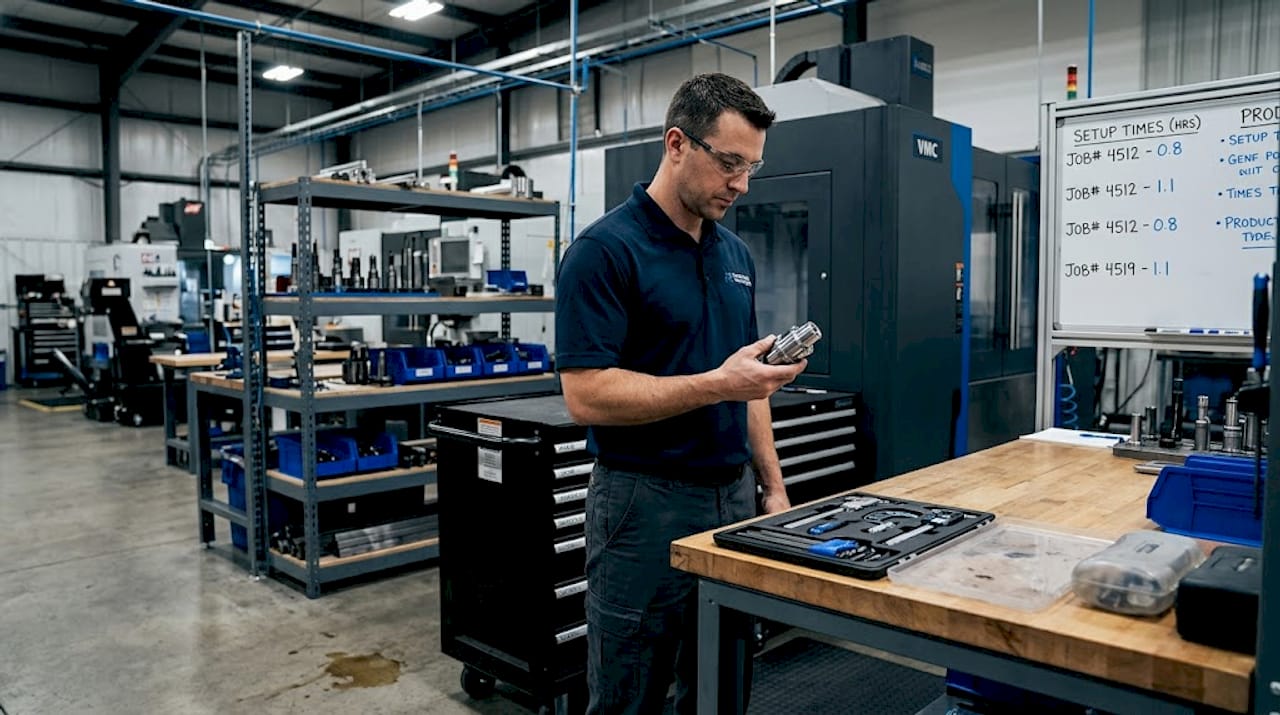
Most machining operations run equipment at 80% or higher utilization and still miss delivery windows, accumulate work-in-process (WIP), and fight rework fires daily. The uncomfortable reality is that machine utilization is not the same thing as production efficiency. A production rate improved from 10 hours per part to under two hours per part in one aerospace shop not by buying faster spindles, but by applying lean principles to eliminate waste at every stage. This guide walks you through those principles, the tools that make them work, and how to start your own lean transformation.
Table of Contents
- What is lean machining?
- The pillars of lean machining
- Reducing setups and changeovers: SMED in action
- Lean machining’s impact: Real-world aerospace and OEM results
- Quality at the source: Lean’s role in reducing rework and scrap
- Getting started: Sequencing your lean machining transformation
- Why most lean machining efforts stall—and how to do it right
- Partnering for lean machining transformation
- Frequently asked questions
Key Takeaways
| Point | Details |
|---|---|
| Lean focuses on value | Lean machining targets value-added work and eliminates process waste instead of maximizing machine utilization. |
| Setup reduction boosts agility | Methods like SMED shrink changeover time, enabling smaller batches, quicker responses, and better workflow. |
| Data-driven gains | Adopting lean principles can result in double-digit improvements in lead time, defect rate, and WIP. |
| Quality built-in prevents waste | Standardizing in-process inspection and fixturing reduces scrap, rework, and downstream production disruptions. |
| Start with value stream mapping | Mapping your production process reveals bottlenecks and prioritizes areas for impactful lean improvements. |
What is lean machining?
Lean machining is the direct application of lean manufacturing principles to CNC and precision machining environments. The goal is not to make machines run faster. It is to make value flow through your shop without interruption, from raw stock to finished, inspected part.
In practice, lean in CNC machining is applied by identifying waste, improving flow, using pull demand signals, and targeting continuous improvement at every process step. For OEMs and aerospace manufacturers, this translates directly to shorter lead times, fewer escapes, and lower per-unit costs across high-volume production runs.
The wastes that lean targets in a machining environment are specific and recognizable:
- Excessive setups that consume hours between every job change
- Waiting between operations when parts queue up at a downstream process
- Rework and quality escapes that require re-inspection and re-machining
- Unnecessary material movement across the shop floor
- Overproduction driven by “keep the machine busy” thinking rather than actual demand
“Lean is not about keeping machines busy. It is about keeping value moving.” That distinction changes every decision you make on the shop floor.
For industrial component machining operations that produce complex, tight-tolerance parts, this framework is particularly powerful. A machine sitting idle waiting for the right fixture is wasting time just as surely as a machine that is cutting bad parts.
The pillars of lean machining
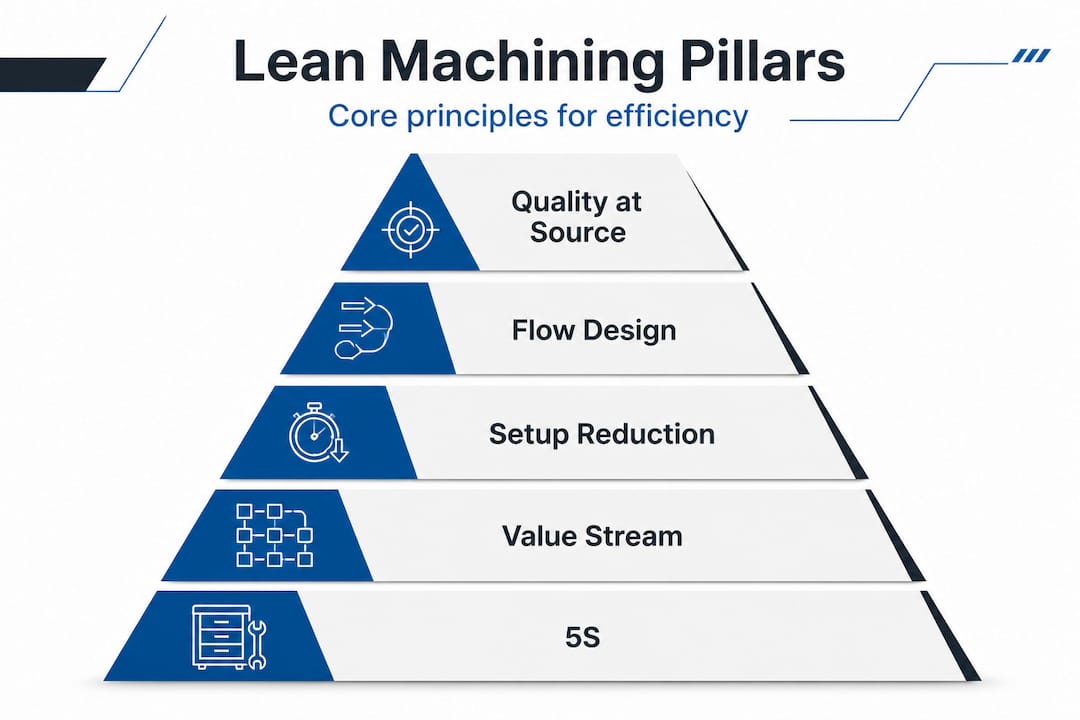
Understanding lean machining means understanding its foundational tools. These are not abstract concepts. Each one targets a specific source of waste and replaces it with a standardized, repeatable practice.
Value stream mapping is the starting point. You draw every step a part takes, from order receipt through shipping, and identify where time accumulates without value being added. Queues, batch delays, and redundant inspections all show up here. Most machining operations discover that parts spend more time sitting and waiting than they spend being cut.
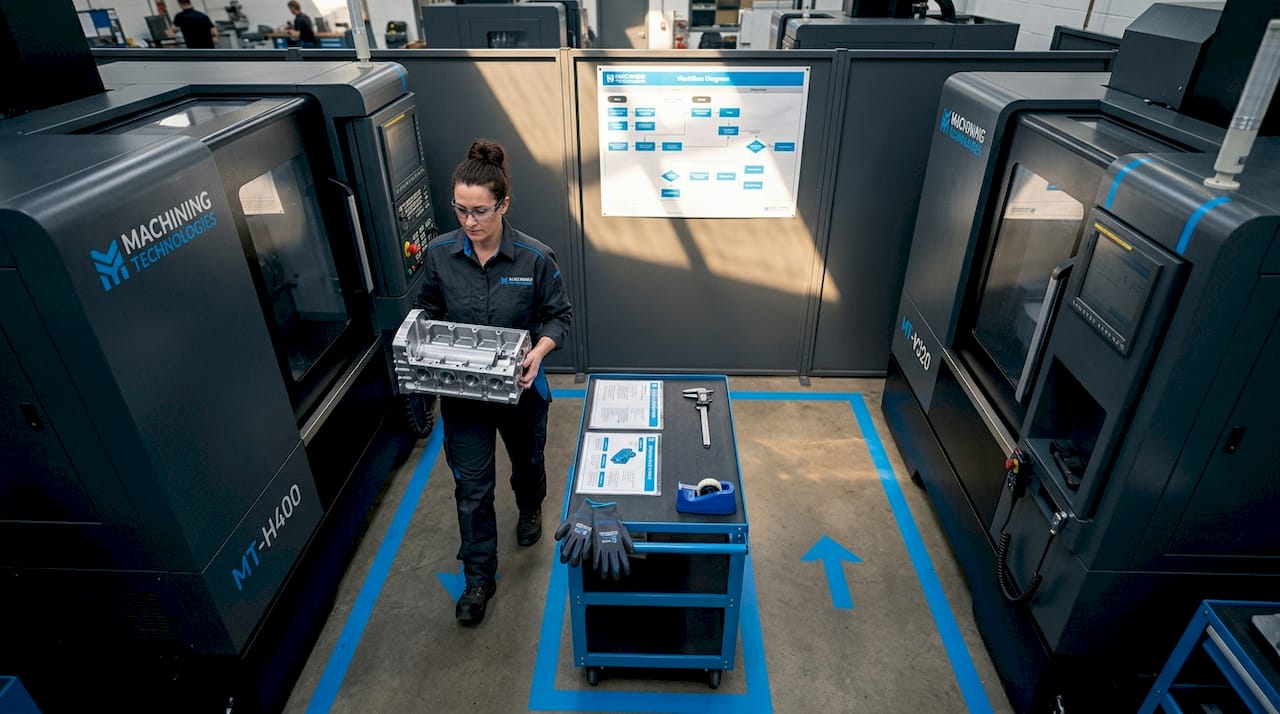
5S is the discipline that makes everything else possible. Sort, Set in Order, Shine, Standardize, and Sustain. A 5S-compliant work cell means tooling is where it is supposed to be, setups are repeatable, and operators are not hunting for fixtures or inserts. In aerospace environments where aerospace machining best practices demand repeatability, 5S is not optional, it is foundational.
Setup reduction via SMED (covered in detail below) collapses the time between jobs, enabling smaller batch sizes and faster response to changing demand.
Design for flow means organizing work cells around the part’s journey, not around the equipment type. Cell-based manufacturing, where turning, milling, and inspection happen in a single cell rather than three separate departments, dramatically cuts transport time and WIP.
Here is how lean thinking compares to traditional machine-centric thinking:
| Traditional approach | Lean machining approach |
|---|---|
| Maximize machine utilization | Maximize value-added work |
| Large batches to reduce setup frequency | Small batches enabled by SMED |
| Centralized inspection at end of line | Quality at the source, in-process |
| Push scheduling by forecast | Pull scheduling by actual demand |
| Success metric: OEE alone | Success metrics: lead time, WIP, defect rate |
Lean implementations emphasize mapping value streams and creating flow rather than maximizing machine utilization alone. The shift in mindset from utilization to flow is where the real efficiency gains live.
Key lean metrics to track:
- Cycle time per part, not just per batch
- Setup time as a percentage of total production time
- First-pass yield and rework rate
- WIP inventory in dollar value and piece count
- On-time delivery rate by customer and part family
Pro Tip: Start tracking setup time as its own metric, separate from run time. Most shops are surprised to find that setups consume 25% to 40% of available machine hours. That number is the first thing lean will help you attack.
The machining equipment efficiency gains available through lean often exceed what new equipment purchases deliver, at a fraction of the cost.
Reducing setups and changeovers: SMED in action
SMED (Single-Minute Exchange of Die) is a key lean methodology for machining shops because it reduces changeover and setup time by separating internal from external work. Internal work is everything that can only happen while the machine is stopped. External work is everything that can happen while the machine is still running.
Most shops run 100% of their setup activities as internal work, simply because that is how it has always been done. SMED challenges that assumption and systematically converts as much internal work to external as possible.
Here is how the SMED process works in practice:
- Observe and document the current setup in real time. Video is extremely useful here.
- Classify every task as internal (machine stopped) or external (machine running).
- Convert internal steps to external wherever possible. Pre-staging fixtures, pre-loading tools on a toolchanger, and pre-measuring offsets offline are all examples.
- Streamline remaining internal steps using standardized fixturing, quick-release clamps, and preset tooling.
- Standardize and train the new process so results are repeatable.
The measurable impact of SMED on a typical machining operation is significant. Consider this before and after example:
| Setup element | Before SMED | After SMED |
|---|---|---|
| Total setup time | 95 minutes | 28 minutes |
| Internal time | 95 minutes | 18 minutes |
| External (while machine runs) | 0 minutes | 10 minutes |
| Machine downtime per changeover | 95 minutes | 18 minutes |
That 81% reduction in downtime per changeover allows a shop to run smaller batches economically. Smaller batches mean faster delivery, lower WIP, and the ability to respond to demand changes without carrying weeks of inventory.
For complex part manufacturing where setups involve multiple fixtures, probing routines, and tight-tolerance verification steps, SMED payoffs are even larger. Each minute of recovered setup time translates directly to available capacity.
Pro Tip: Focus first on your highest-mix, highest-volume part families. Converting even two or three setup activities from internal to external on your most frequently changed jobs will produce measurable capacity gains within weeks, not months.
Lean machining’s impact: Real-world aerospace and OEM results
Given lean’s foundations and tactical tools, what results should you expect? The data from aerospace and OEM deployments is consistent and compelling.
In a documented aerospace study, defect rate dropped by 66%, cycle time was reduced with 43% of savings attributed directly to lean practice implementation, and WIP decreased substantially across production cells. These are not incremental improvements. They represent structural changes to how work flows through a facility.
In a separate precision CNC application, a machine shop achieved a production rate improvement from 10 hours per part to under two hours per part, an 80% reduction, through a combination of better fixturing, in-process inspection, and lean flow principles.
Here is what before and after lean typically looks like across key metrics:
| Metric | Pre-lean baseline | Post-lean result | Improvement |
|---|---|---|---|
| Lead time | 14 days | 4 days | 71% reduction |
| Defect rate | 4.5% | 1.5% | 66% reduction |
| Cycle time per part | 10 hours | 2 hours | 80% reduction |
| WIP inventory | High | Significantly lower | Major reduction |
| Setup time | 95 min/changeover | 28 min/changeover | 70%+ reduction |
“The biggest shock for most operations is not how much waste exists, but how long it was invisible.” Once you map the value stream, that invisibility disappears permanently.
The specific benefits lean delivers to aerospace and OEM procurement managers include:
- Predictable delivery because flow is controlled rather than reactive
- Lower unit cost driven by less rework, less scrap, and less WIP carrying cost
- Better supplier relationships because smaller, more frequent orders are now economical
- Reduced inspection overhead because quality is built in rather than sorted out at the end
For teams sourcing precision parts manufacturing for critical applications, these improvements directly affect program cost and schedule risk. Lean is not a manufacturing curiosity. It is a competitive requirement for aerospace machining processes operating under tight quality and delivery constraints.
Quality at the source: Lean’s role in reducing rework and scrap
Lean machining’s measurable success depends on robust quality practices embedded directly into the production process. Not at the end. Not in a separate inspection department. Inside the cell, at the time the part is made.
“Quality at the source” means operators have the tools, authority, and standard criteria to detect and correct problems during machining. When a misalignment is caught mid-cycle by a probe rather than discovered at final inspection, the cost and delay are a fraction of what downstream rejection would cause.
Probe-assisted in-process inspection can support lean by preventing rework and scrap, and by shortening the time between misalignment detection and corrective action. Standardized fixturing reinforces this by ensuring every part is presented to the tool in exactly the same position, eliminating a major source of variation.
Key benefits of building quality into the machining process:
- Less scrap because non-conforming conditions are caught before they become scrapped parts
- Lower rework cost because corrections happen immediately rather than after full batch completion
- Reduced unplanned downtime because systematic issues surface faster and get resolved sooner
- Shorter inspection cycle time because first-pass yield improves and full re-inspection becomes less frequent
Pro Tip: Design your quality gates around the features that drive the most rework and the most customer returns. In aerospace machining, bore diameters and critical datums are almost always the culprits. Probe those features in-process before the part leaves the fixture.
Embedding quality at the source connects directly to aerospace machining standards requirements and ensures that lean flow gains are not undermined by downstream quality problems that restart the clock on lead time.
Getting started: Sequencing your lean machining transformation
Understanding the principles is only step one. Here is how to begin a lean machining transformation and structure it for lasting results.
A practical sequencing approach is to map the value stream end-to-end first, then tackle the biggest loss drivers such as setups, changeovers, and queueing rather than assuming high utilization means you are already lean. Sequence matters enormously. Shops that jump to tool upgrades before addressing flow typically accelerate their bottlenecks without solving them.
Follow this sequence:
- Map the current state value stream for your highest-volume part families. Include all steps, all wait times, all transport moves.
- Identify the top three loss drivers by time and cost. Typically these are setups, WIP queues, and rework loops.
- Apply SMED to your most frequent changeovers and track setup time before and after.
- Reorganize work cells around flow rather than equipment type where feasible.
- Implement in-process quality checks at the steps that generate the most rework.
- Measure and review weekly using lead time, WIP, defect rate, and on-time delivery.
Lean improvement benefits are realized via measurable operational metrics, specifically lead time and unit cost reductions, and tracking those metrics from day one creates accountability.
Pitfalls to avoid:
- Over-focusing on utilization instead of throughput and flow
- Skipping value stream mapping and jumping straight to tool or machine upgrades
- Treating lean as a one-time project rather than an ongoing operating discipline
- Ignoring the shop floor team whose daily observations are your best source of improvement opportunities
Pro Tip: Your machinists and setup technicians know exactly where time is wasted. Involve them from the start of your value stream mapping session. Their input turns a four-hour mapping exercise into a six-month roadmap of actionable improvements.
Connecting lean principles to automating machining processes creates compounding benefits. Automation without lean flow just automates the waste. Lean without automation eventually hits a capacity ceiling. The combination is where transformational results come from.
Why most lean machining efforts stall—and how to do it right
After nearly four decades of precision machining, we have seen lean initiatives succeed dramatically and fail quietly. The pattern in the failures is almost always the same. Teams focus on cutting parameters, spindle speeds, and feed rates because those numbers are visible, measurable, and feel like machining problems. They are not lean problems.
Lean initiatives that focus only on cutting parameters can fail if fixturing, setup verification, and in-process quality gates are not standardized. A faster spindle speed in an unstable fixture produces faster scrap. Optimized feed rates through a non-repeatable setup produce highly efficient variation.
The overlooked work is standardization. Standardized fixturing means every setup produces the same part orientation every time. Standardized setup verification means every operator confirms the same critical dimensions before cutting begins. Standardized quality gates mean problems surface at the earliest possible moment, not after a full batch has been run.
We have also seen lean efforts stall because leadership treats it as a shop floor initiative rather than an operational strategy. Lean requires procurement to allow smaller order quantities. It requires scheduling to prioritize flow over utilization. It requires engineering to design fixtures with repeatability, not just function, in mind. When any one of those functions operates outside the lean framework, the gains erode.
The shops that sustain lean gains over years share one characteristic: they connect aerospace machining best practices for quality and verification directly into their lean work cells. Flow and quality are not competing priorities. In a well-designed lean machining environment, they reinforce each other constantly.
Partnering for lean machining transformation
If your team is ready to pursue lean machining, consider a partnership with proven experts who have spent decades refining these methods in high-volume, high-precision environments.
At Machining Technologies LLC, we produce over 20 million parts annually from our 70,000 square foot Webster, Massachusetts facility, running lean principles across Hydromat rotary transfer systems, CNC milling, turning, and wire EDM. Our precision parts manufacturing services are built around the flow, quality, and repeatability that lean demands. Explore our aerospace machining workflow optimization resources to see how we structure lean-ready production for OEM and aerospace programs. When you are ready to discuss your specific part families and production volumes, our CNC milling and turning services page outlines our capabilities in detail.
Frequently asked questions
What are the main wastes targeted by lean machining?
Lean machining targets excessive setups, waiting, rework, unnecessary movement, and inventory as the primary waste categories in precision machining environments.
How does lean machining improve aerospace part lead times?
By reducing setups and building quality into the process, lean machining can deliver up to 80% faster lead times for aerospace parts, as documented in real production environments.
What is SMED and why is it important in machining?
SMED reduces changeover and setup time by separating internal from external work, enabling smaller batches and more flexible scheduling without requiring capital investment in new equipment.
How can procurement managers track the success of lean machining?
Key benchmarks are lead time, unit cost, defect rate, and WIP, all of which empirical research confirms improve measurably after lean implementation in CNC machining environments.
What’s the first step to start lean machining?
Map the value stream end-to-end for your highest-volume part family, then identify and attack the biggest sources of wasted time before touching any machine parameters.
Recommended
- Advanced machining equipment: efficiency gains and ROI | Machining Technologies
- Why Automate Machining Processes: Boosting OEM Efficiency | Machining Technologies
- Machining Trends 2026: 40% Faster Lead Times + 50% Tool Life | Machining Technologies
- High-Volume Manufacturing Benefits for Precision Parts | Machining Technologies