
TL;DR:
- Subcontract machining offers OEMs flexible capacity, cost efficiency, and access to advanced technology.
- Process optimization and custom fixtures dramatically reduce cycle times and improve quality.
- Successful partnerships involve early collaboration, technical trust, and clear communication.
Outsourcing machining carries a reputation for risk. Many procurement managers assume that handing off precision work to an outside shop means sacrificing control, tolerances, or delivery timelines. That assumption costs OEMs real money. Subcontract machining, when structured correctly, solves the capacity and capability constraints that hold aerospace, defense, and industrial manufacturers back. This guide walks you through exactly what subcontract machining is, why it delivers measurable advantages for high-precision industries, how process optimization drives results, and what separates a great machining partner from a costly mistake.
Table of Contents
- What is subcontract machining?
- Advantages of subcontract machining for OEMs, aerospace, and defense
- Custom fixtures and process optimization: The hidden drivers of success
- Selecting a subcontract machining partner: Key criteria and pitfalls
- The real secret to effective subcontract machining partnerships
- Take the next step: Connect with precision machining experts
- Frequently asked questions
Key Takeaways
| Point | Details |
|---|---|
| Rapid scalability | Subcontract machining lets OEMs quickly expand production capacity without costly facility upgrades. |
| Precision advantage | Expert subcontractors use advanced tooling and custom fixtures to deliver exceptional accuracy. |
| Strategic partner selection | Choosing the right partner is critical for consistent quality and secure operations. |
| Collaboration drives results | Joint process optimization between OEMs and subcontractors maximizes efficiency and throughput. |
What is subcontract machining?
Subcontract machining is a manufacturing arrangement where an OEM or prime contractor outsources specific machining operations to a specialized external shop. The subcontractor receives drawings, specifications, and raw material or blanks, then produces finished or semi-finished components to the buyer’s exact requirements. The OEM retains design ownership and quality standards. The subcontractor delivers the execution.
This model fits neatly into the broader manufacturing supply chain. Think of it as a tiered structure: the OEM sits at the top, managing product design and final assembly. Subcontractors sit one level down, handling the physical machining work. Procurement managers serve as the connective tissue, vetting suppliers, managing contracts, and ensuring parts arrive on spec and on time.
The typical workflow follows a clear sequence:
- Request for Quotation (RFQ): The OEM submits drawings, tolerances, material specs, and target volumes.
- Quoting and DFM review: The subcontractor reviews the design for manufacturability and returns pricing with lead times.
- Purchase order and scheduling: Once terms are agreed, the job enters the shop’s production queue.
- Machining and in-process inspection: Parts are machined using CNC milling, turning, Hydromat systems, or EDM, with ongoing quality checks.
- Final inspection and shipping: Finished components are inspected against print, documented, and delivered.
The key difference between subcontract and in-house machining comes down to fixed versus variable cost structure. In-house machining requires capital investment in equipment, trained operators, and floor space. Subcontract machining converts that fixed overhead into a variable cost tied directly to production volume. Subcontract machining enables OEMs to maintain quality and rapid throughput without expanding in-house facilities.
For OEMs evaluating this model for the first time, reviewing the full scope of contract machining benefits helps clarify where the model fits best. A broad look at available machining services also helps procurement teams understand what modern subcontractors can actually deliver.
Advantages of subcontract machining for OEMs, aerospace, and defense
Once you understand the structure, the strategic advantages become clear. Subcontract machining is not just a stopgap for overflow work. For demanding industries like aerospace and defense, it is often the smarter long-term model.
Rapid capacity scaling is the most immediate benefit. When a defense contractor wins a large program, they cannot wait 18 months to install new equipment and hire operators. A qualified subcontractor with available capacity can absorb that volume in weeks. This flexibility is critical when program timelines are fixed and penalties for late delivery are real.
Cost efficiency is the second major driver. Purchasing a 5-axis CNC machining center costs anywhere from $200,000 to over $1 million. Add tooling, maintenance, and operator wages, and the break-even point on in-house machining is far out on the horizon. Subcontract machining lets you pay per part, not per machine.
Access to specialized technology is often underestimated. Top-tier subcontractors invest heavily in equipment and process development because machining is their core business. An OEM running a mixed production environment rarely justifies the same level of investment. Precision machining benefits become accessible without the capital risk.
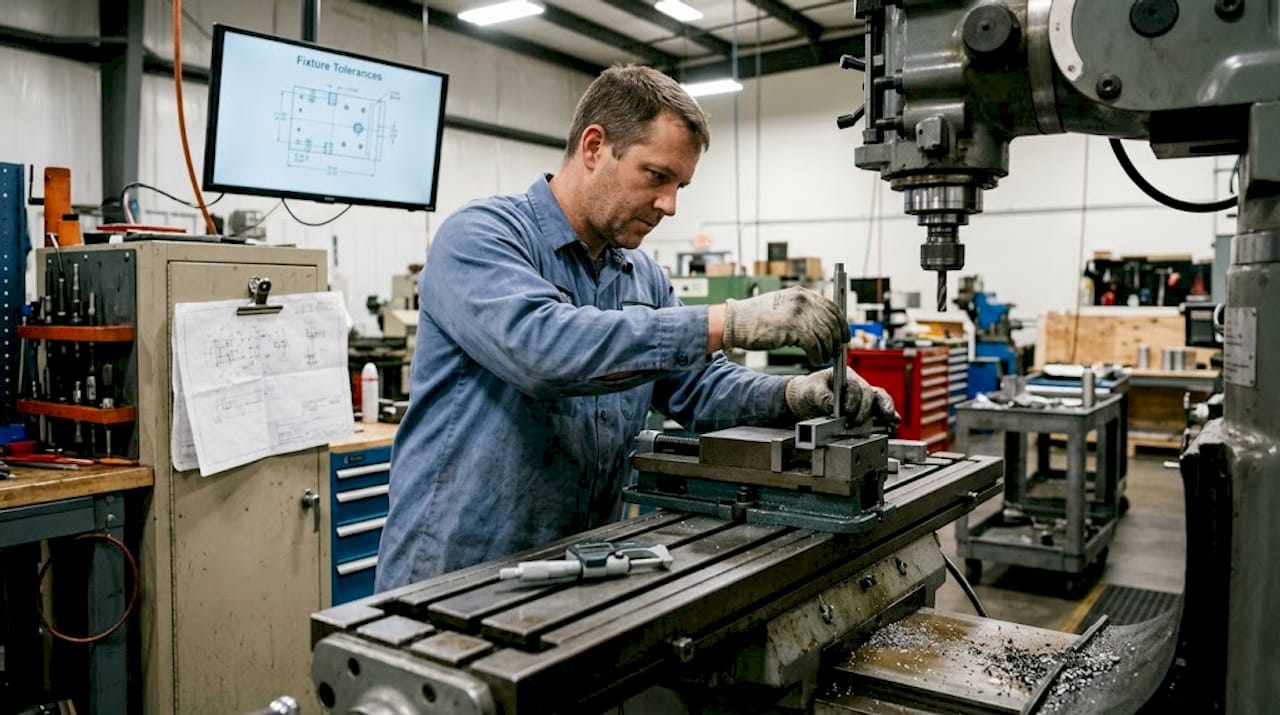
The efficiency gains can be dramatic. LeanWerks reduced machining time on aluminum investment castings from 10 hours per part to under 2 hours through custom fixturing, probing, and powRgrip tooling. That kind of result is only achievable when a shop is laser-focused on process optimization. The automated machining advantages that modern subcontractors offer simply cannot be replicated on a part-time basis in-house.
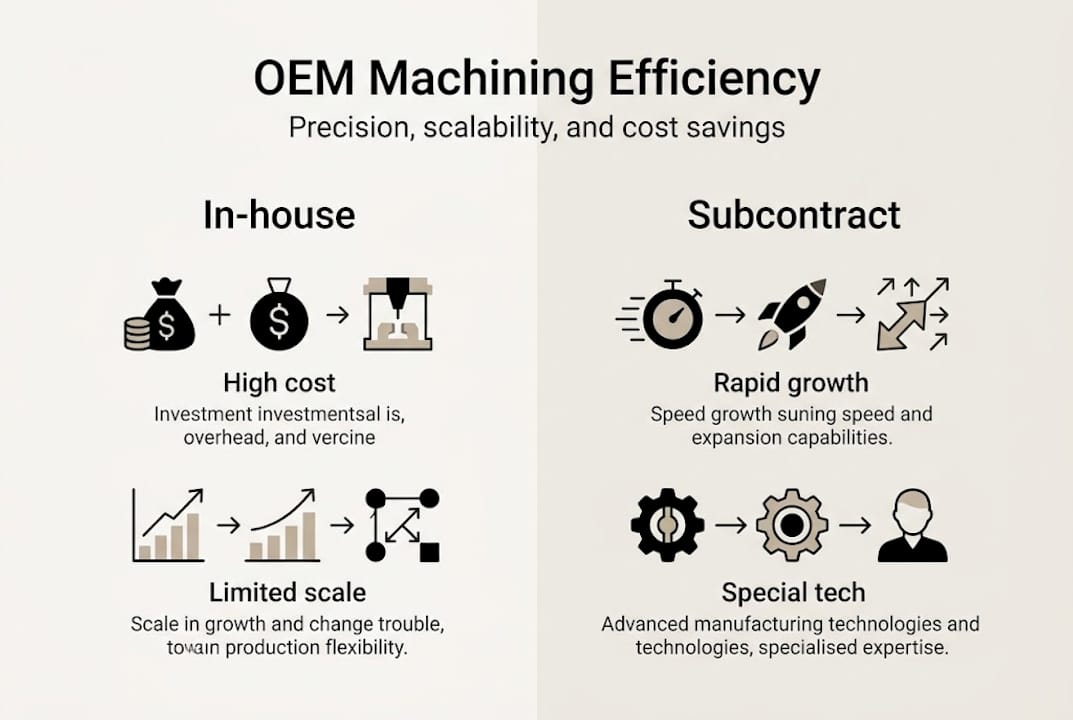
| Factor | In-house machining | Subcontract machining |
|---|---|---|
| Capital investment | High | None |
| Scalability | Limited | High |
| Access to specialized tech | Moderate | High |
| Fixed overhead | High | Low |
| Lead time flexibility | Low | High |
| Quality control | Variable | Contractually defined |
Pro Tip: When evaluating subcontract options, ask potential partners for documented cycle time improvements on similar part families. A shop that tracks and shares process data is one that takes continuous improvement seriously.
Custom fixtures and process optimization: The hidden drivers of success
Many OEMs focus on machine type and material capability when vetting subcontractors. That is a reasonable starting point, but it misses the real differentiator: how a shop approaches fixturing and process optimization.
Custom fixtures hold a part in exactly the right position and orientation during machining. A generic vise setup introduces variability. A purpose-built fixture eliminates it. For complex aerospace components with tight geometric tolerances, the fixture design is often as important as the cutting tool selection.
The data backs this up. Custom fixturing and powRgrip tooling helped reduce machining time by over 80% on aluminum investment castings, a result that transformed production economics entirely. That is not a marginal improvement. It is a fundamental shift in what is possible.
Here is a step-by-step approach to implementing process optimization with a subcontractor:
- Share full design intent early. Provide GD&T callouts, critical features, and assembly context before the RFQ stage. The more context the shop has, the better their fixture and toolpath design.
- Request a DFM (Design for Manufacturability) review. A capable subcontractor will identify features that drive cost or risk before cutting starts.
- Collaborate on fixture design. Do not treat fixturing as the shop’s problem alone. Your engineering team’s input on part loading and datum selection can prevent costly rework cycles.
- Establish in-process probing protocols. On-machine probing catches deviations in real time, reducing scrap and ensuring first-article approval goes smoothly.
- Review cycle time data after first production runs. Use this data to drive continuous improvement on subsequent orders.
| Process stage | Without optimization | With optimization |
|---|---|---|
| Cycle time per part | 10+ hours | Under 2 hours |
| Scrap rate | Higher | Significantly reduced |
| First-article pass rate | Variable | Consistently high |
| Setup time | Long | Minimized via fixtures |
For high-volume aerospace programs, reviewing a proven high-volume machining workflow gives procurement teams a benchmark for what best-in-class execution looks like. Teams working on tightly regulated components can also benefit from studying a precision machining workflow for firearms as a reference for rigorous process discipline. When geometry gets complicated, dedicated complex part strategies become essential.
Pro Tip: Engage your subcontractor’s process engineers during the design phase, not after the drawing is released. Early collaboration on fixture and tooling design consistently produces faster cycle times, lower scrap rates, and smoother production launches.
Selecting a subcontract machining partner: Key criteria and pitfalls
Choosing the wrong subcontractor is expensive. Rework, missed deliveries, and quality escapes in aerospace or defense programs carry consequences far beyond the cost of the parts themselves. A structured vetting process protects you.
Start with technical criteria:
- Machine capability: Does the shop run the equipment required for your part geometry? 5-axis milling, multi-spindle turning, wire EDM, and Hydromat systems each serve different applications.
- Tolerance capability: Ask for documented Cpk data on similar features. A shop that cannot provide process capability data is not ready for aerospace work.
- Certifications: ISO 9001 is a baseline. AS9100 is the standard for aerospace. ITAR registration is non-negotiable for defense work.
- Inspection equipment: CMMs, optical comparators, and surface profilometers should be in-house, not outsourced to a third party.
- Capacity and lead times: Verify actual available capacity, not just theoretical throughput. Ask how they handle surge demand.
Operational factors matter just as much:
- Communication responsiveness during the quoting and production process
- Willingness to share in-process data and inspection reports
- Flexibility to accommodate design changes mid-run
- Financial stability and long-term viability as a partner
For defense and aerospace programs, compliance and IP protection require explicit attention. Confirm ITAR registration, review their data security protocols, and include IP protection clauses in the supply agreement before any drawings are shared.
“Optimal machining outcomes depend heavily on partner selection, technical capabilities, and ongoing collaboration.”
Common pitfalls to avoid: selecting on price alone, skipping facility audits, and failing to define quality acceptance criteria in writing before production starts. The best OEM contract machining relationships are built on documented expectations, not assumptions. Understanding the tradeoffs between custom vs. standard machining also helps procurement teams write better RFQs from the start.
The real secret to effective subcontract machining partnerships
Here is what most OEMs get wrong: they treat subcontract machining as a vendor transaction rather than a technical collaboration. They send a drawing, receive parts, and measure success purely by price and on-time delivery. That approach leaves significant performance on the table.
The shops that consistently deliver the best results are the ones that get pulled into the design process early. They flag features that are expensive to machine, suggest material substitutions that hold tolerance better, and co-develop fixturing strategies before the first chip is cut. That kind of integration requires trust, and trust requires investment from both sides.
After working in this industry since 1985, the pattern is unmistakable. OEMs that share program context, involve their subcontractors in DFM reviews, and treat process data as a shared asset consistently outperform those that keep their partners at arm’s length. The contract machining speed gains that matter most come from relationship depth, not just machine speed.
If your current subcontract relationships feel purely transactional, that is the first thing worth changing.
Take the next step: Connect with precision machining experts
If you are sourcing high-precision components for aerospace, defense, or industrial programs, the right subcontract partner makes a measurable difference in cost, quality, and delivery. Machining Technologies LLC has been producing over 20 million parts annually from our 70,000 square foot facility in Webster, Massachusetts since 1985.
We specialize in precision parts manufacturing for OEMs that cannot afford quality escapes or missed delivery windows. Our capabilities span CNC milling and turning, Hydromat systems, and wire EDM, all under one roof. Explore our OEM contract machining solutions and connect with our engineering team to discuss your next program.
Frequently asked questions
How does subcontract machining ensure high precision for aerospace components?
Subcontract machining shops use advanced CNC technology, custom fixtures, and rigorous in-process inspection to achieve the tight tolerances aerospace programs demand. Custom fixturing and probing have been shown to reduce cycle time by over 80% while improving dimensional consistency.
What is the difference between in-house and subcontract machining?
In-house machining relies on company-owned equipment and staff, creating fixed overhead regardless of production volume. Subcontract machining converts that overhead into a variable cost tied to actual output, giving OEMs greater flexibility and access to specialized capabilities without capital investment.
What should OEMs look for when selecting a subcontract machining provider?
OEMs should evaluate machine capability, tolerance documentation, certifications like AS9100 and ITAR, in-house inspection equipment, and lead time flexibility. Optimal machining outcomes depend on partner selection, technical depth, and ongoing collaboration throughout the program.
Can subcontract machining improve production throughput for high-volume orders?
Yes. Process optimization techniques combined with custom fixturing have reduced machining time by over 80% on complex parts, directly increasing throughput without adding capital equipment on the OEM’s side.